
What I Learned About Public Speaking When I Least Expected To
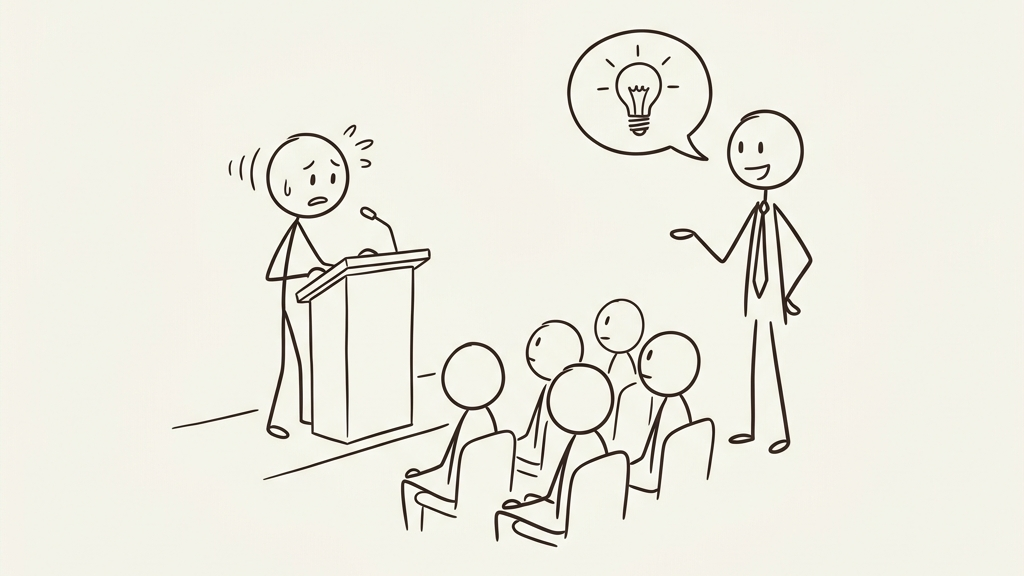
Illustration generated by Gemini
A few days ago, my CTO asked me to prepare a topic from Alex Xu's System Design book, Proximity Service. He mentioned we would discuss it, so I spent the next couple of days going through it properly. Trade-offs, geohashing, quad trees, the works. By the time I closed the book, I felt ready for a sharp, technical, back and forth conversation. The kind you have with someone who already speaks the same language.
Post lunch, I walked over to his cabin, expecting exactly that. A quiet one on one, whiteboard optional.
"Let's grab a meeting room and call the others too."
I nodded like it was nothing. It was not nothing. My head was already recalculating everything I had prepared for.
The room filled up faster than I expected. Some faces I knew from standups, some I did not know at all. Roughly half the room had no technical background whatsoever. And there I was, about to open with geohashing.
I started explaining it in what I thought were simple terms. Simple to me. I had stripped away as much jargon as I could, or so I believed. But simple, when it comes from inside a technical brain, is still technical. Every sentence made complete sense to the engineers in the room and slid right off everyone else. I could see it in their faces, the polite nodding that means someone has quietly checked out.
That is when my CTO stepped in.
He did not correct me. He did not take over the topic. He took the exact thing I had just said and handed it back to the room wrapped in an analogy, something so simple and so obvious in hindsight that I remember thinking, that is exactly what I was trying to say and could not find the words for.
And he did not stop after one save. For the rest of the session, every single time I explained something in my technical way, he would follow right behind me and translate it. Same analogy family throughout, never switching metaphors halfway. I watched the non technical folks in the room go from polite nodding to actually leaning in, asking follow up questions, getting it.
By the end of the session, everyone in that room understood proximity service. I understood something else.
I had walked in thinking the hard part was knowing the answer. It was not. The hard part was realizing that what feels simple to you is not the same as what is simple for someone else, and watching my CTO close that exact gap in real time, taking something I genuinely believed I had already simplified and simplifying it again, without losing a single bit of accuracy in the process. I had one half of that skill. My CTO had both halves, and he moved between them so smoothly that it looked effortless, which is usually the biggest sign that it is not.
There was a smaller moment buried in all of this too. When my CTO first said “we will discuss it,” I had quietly filled in the rest myself, the format, the setting, the audience, none of which he had actually confirmed. I built an entire mental picture out of one vague sentence and walked in prepared for a meeting that was never going to happen. A five second follow up question that day would have saved me thirty minutes of quietly recalibrating in front of a room full of people.
I went in that afternoon to explain a system design concept. I walked out having watched a masterclass in something else entirely. The difference between being right and being understood, and how much work actually sits in that gap.